MENÚ
AR | ARS

AR | ARS
-
- Todas las pipetas, dispensadores y manipuladores de líquidos automatizados
- Pipetas mecánicas
- Pipetas electrónicas
- Pipetas multicanal
- Pipetas y dispensadores de desplazamiento positivo
- Dispensadores de botella
- Controladores de pipetas
- Accesorios para dispensadores y pipetas
- Pipeteo automatizado
- Consumibles para automatización
- Accesorios de automatización
- Servicios de manipulación de líquidos y pipetas
Sorry, we couldn't find anything on our website containing your search term.
Está a punto de abandonar este sitio.
Por favor, tenga en cuenta que su carro de la compra actual no ha sido guardado todavía y no podrá ser restablecido en el nuevo sitio ni cuando regrese. Si desea guardar su carro de la compra, inicie sesión en su cuenta.
Sorry, we couldn't find anything on our website containing your search term.
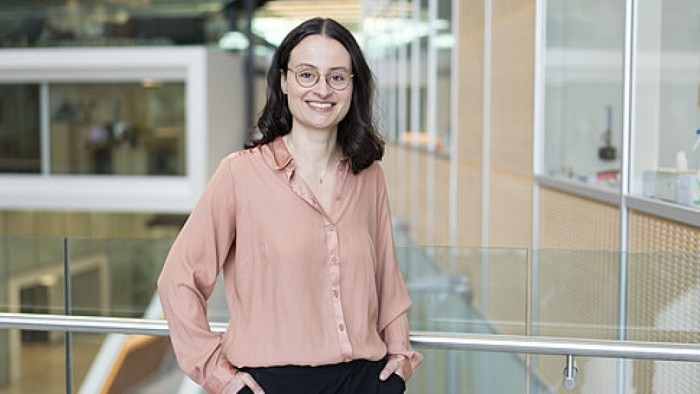
2025 Award Finalist Dr. Juliette Fedry
After studying at École Polytechnique, Juliette Fedry completed her PhD with Felix Rey at Institut Pasteur Paris. She identified the first known sperm-egg fusion protein, HAP2, and showed that it was homologous to viral fusion proteins. During her postdoc with Friedrich Förster at Utrecht University, she used cryo-electron tomography to visualize protein translocation into the endoplasmic reticulum. This work allowed the identification, quantification and spatial analysis of the different translocon variants on native membranes. Juliette next implemented Focused Ion Beam milling approaches to visualise translation in entire mammalian cells and its reorganization upon ribosome collision stress. These studies provided a framework for quantitative analysis of translation dynamics in situ.
Synopsis of the research:
My research combines functional and structural approaches across scales to address long standing questions in cell biology.
During my PhD, I identified HAP2 as the first eukaryotic gamete fusion protein and determined its crystal structure, revealing homology with viral fusion proteins.
As a postdoc, I developed my research towards larger length scales and native cellular contexts. I established a workflow for high-resolution subtomogram averaging in native human endoplasmic reticulum (ER) membranes. These results uncovered fundamental insights into how various types of nascent protein chains recruit different ER translocon complexes to enter the secretory pathway. I further developed FIB-milling approaches to visualize translation in intact mammalian cells, revealing that the elongation factor eEF1A remains bound to human ribosomes during proofreading after hydrolysis. This finding contributes to rationalise why the human ribosome operates slower than its bacterial counterpart.
I leveraged these methods to elucidate the effect of cellular stress on translation dynamics and on the remodelling of the nuclear membrane.
I recently started my group at the MRC LMB, where I develop an integrative approach to study the regulation of proteostasis networks in healthy and diseased mammalian cells.
Synopsis of the research:
My research combines functional and structural approaches across scales to address long standing questions in cell biology.
During my PhD, I identified HAP2 as the first eukaryotic gamete fusion protein and determined its crystal structure, revealing homology with viral fusion proteins.
As a postdoc, I developed my research towards larger length scales and native cellular contexts. I established a workflow for high-resolution subtomogram averaging in native human endoplasmic reticulum (ER) membranes. These results uncovered fundamental insights into how various types of nascent protein chains recruit different ER translocon complexes to enter the secretory pathway. I further developed FIB-milling approaches to visualize translation in intact mammalian cells, revealing that the elongation factor eEF1A remains bound to human ribosomes during proofreading after hydrolysis. This finding contributes to rationalise why the human ribosome operates slower than its bacterial counterpart.
I leveraged these methods to elucidate the effect of cellular stress on translation dynamics and on the remodelling of the nuclear membrane.
I recently started my group at the MRC LMB, where I develop an integrative approach to study the regulation of proteostasis networks in healthy and diseased mammalian cells.
Leer más
Downloads

PDF 2,50 MB
PDF 0,54 MB